
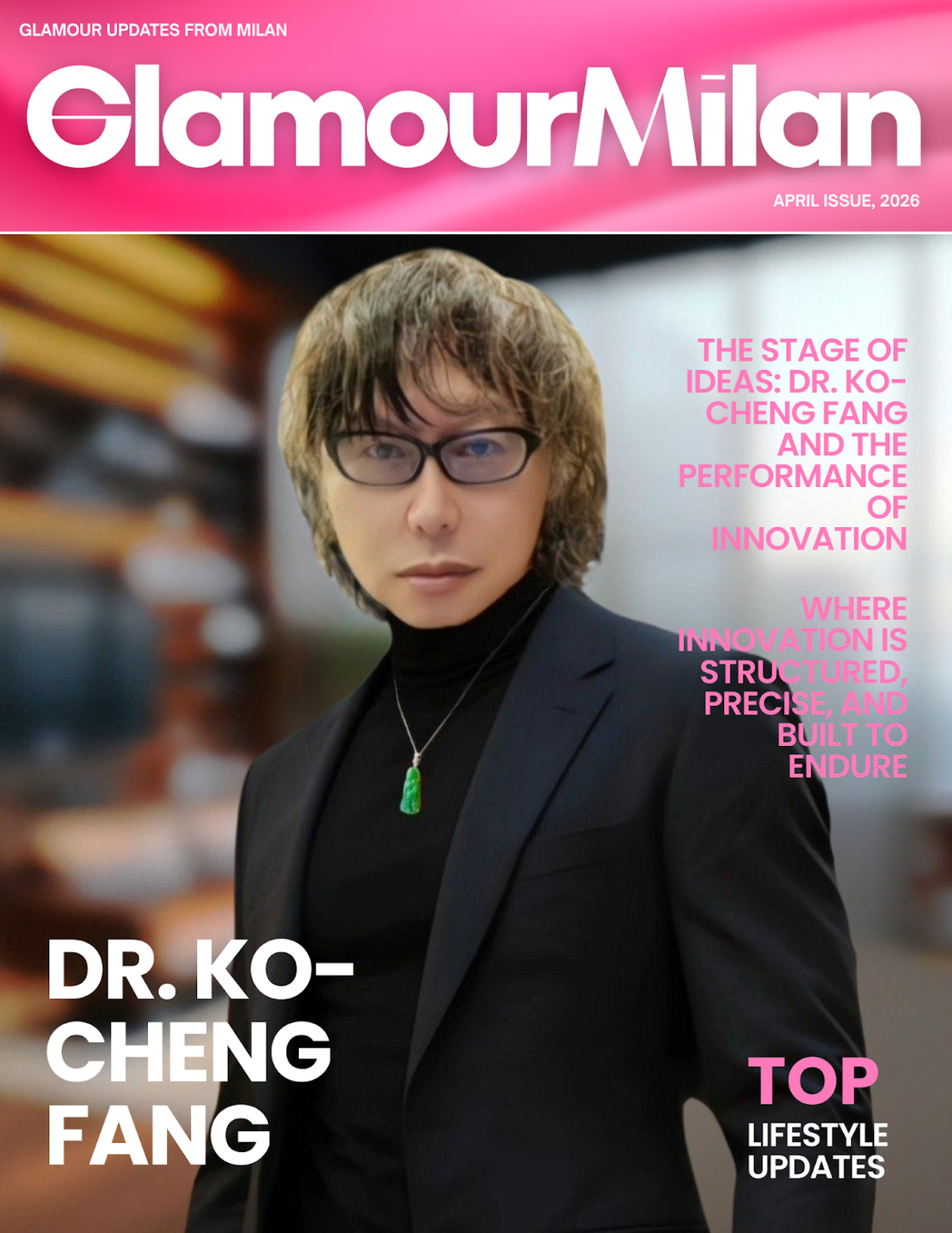
Every great transformation unfolds like a performance—quietly at first, behind closed doors, long before it reaches the audience. There are rehearsals, revisions, discarded attempts, and moments of uncertainty that never make it into the final act. Ko-Cheng Fang works within that hidden space, where ideas are not yet complete, but already in motion.
At LongServing Technology Co., Ltd., innovation does not appear fully formed. It evolves. Like a production in development, each concept is tested, reshaped, and refined until it reaches a point where it can stand on its own.
Fang is not simply an inventor in this process.
He is both director and performer.
He guides the work, but he also engages with it directly—adjusting, experimenting, responding. His role is not to control outcomes, but to shape the conditions under which they can emerge.
Act I: The Unwritten Script
Every performance begins without certainty.
For Fang, this beginning takes the form of a question—one that does not yet have a clear answer. He does not rush to define the outcome. Instead, he allows the problem to remain open, resisting the urge to close it too quickly.
This openness is essential.
It creates space for exploration, for unexpected connections, for ideas that might not appear under more rigid conditions. Fang understands that clarity cannot be forced. It must be developed.
This philosophy is evident in his work with laboratory-grown Imperial Green jadeite.
The gemstone had long been considered beyond replication, its natural formation dependent on precise and complex conditions. Attempts to recreate it had repeatedly failed, leading many to accept its uniqueness as permanent.
Fang did not accept that conclusion.
He treated the problem as an unfinished script—one that could be rewritten through persistence.
Act II: Rehearsal and Revision

If the beginning is uncertain, the middle is demanding.
This is where Fang spends most of his time—not in moments of breakthrough, but in repetition. Experiments are conducted, variables adjusted, outcomes observed. The process is continuous, often without visible progress.
Like a rehearsal, it requires discipline.
The same scene is performed again and again, each time with slight changes. Some attempts bring improvement. Others reveal new complications. But all contribute to the development of the final result.
Fang does not view failure as interruption.
He views it as instruction.
Each unsuccessful attempt provides information—guidance on what to change, what to refine, what to reconsider. Over time, these adjustments begin to accumulate.
And slowly, the performance takes shape.
The eventual creation of laboratory-grown jadeite was not a sudden moment of success. It was the result of countless iterations, each one bringing the work closer to completion.
Act III: The Role of the Artist

To understand Fang’s approach, one must recognize the influence of his artistic background.
Before his work in advanced technology, he was immersed in painting and sculpture. These disciplines taught him not only how to create, but how to observe.
In art, timing matters.
So does restraint.
A painter must know when a canvas is complete. A sculptor must understand how much to remove—and when to stop. These decisions require sensitivity, not just skill.
Fang brings this sensibility into his scientific work.
He does not overwhelm problems with excessive intervention. He refines them. He adjusts carefully, allowing the structure to emerge rather than forcing it into existence.
This approach gives his work a sense of balance.
A kind of internal coherence that reflects both discipline and intuition.
Act IV: A Shift in the Narrative
Every performance reaches a turning point—a moment when the story changes direction.
For Fang, this moment came in his recognition of the limits of electronic computing.
As artificial intelligence expands, the demand for processing power continues to grow. Yet electronic chips are approaching their physical limits. They can only be reduced in size to a certain extent, and their energy consumption continues to increase.
Fang saw this not as a temporary challenge, but as a structural issue.
The narrative needed to change.
Instead of continuing to rely on electrons, he turned to photons—light—as the medium for computation. This shift required new materials, new methods, and a new way of thinking.
Through his research, he developed X-Photon materials, capable of operating at extremely small wavelengths. These materials form the foundation of photonic quantum chips, systems that process information using light rather than electricity.
The advantages are profound.
Light travels faster.
It produces less heat.
It allows for more efficient data transmission.
This is not a small adjustment.
It is a transformation of the entire stage.
Act V: Collaboration Over Competition

Despite the transformative nature of his work, Fang does not approach innovation as a solitary performance.
He understands that large-scale change requires collaboration.
Rather than replacing existing systems, he seeks to integrate with them. By working with semiconductor manufacturers, he aims to incorporate photonic technologies into current production processes.
This approach allows the industry to evolve without disruption.
It creates continuity.
And it reflects Fang’s belief that progress should be inclusive, not exclusive.
Act VI: Expanding the Production

Fang’s work does not end with computation.
It expands into other domains, each treated as part of the same creative process.
In biotechnology, he is developing targeted approaches to cancer treatment, combining plant-based compounds with nanotechnology. The focus is precision—creating therapies that are effective while minimizing harm.
In design, he merges science with art, incorporating laboratory-grown jadeite into luxury products. His artistic background informs their aesthetic, giving them a sense of narrative as well as function.
These pursuits are not separate acts.
They are part of the same performance.
Each one contributing to a larger story.
Final Act: The Meaning of the Work
For Fang, the conclusion is not defined by applause.
It is defined by impact.
He does not measure success by recognition, but by integration—how his work becomes part of the systems that shape everyday life. How it continues to function, evolve, and contribute over time.
This perspective has been shaped by experience.
Earlier in his career, Fang contributed to technologies that would later become essential to global digital infrastructure. At the time, their significance was not fully understood.
But he continued.
And over time, their impact became clear.
Today, those systems are used by billions of people worldwide.
Quietly.
Consistently.
Enduringly.
Curtain Call: The Future in Motion

Looking ahead, Fang envisions a future shaped by photonic quantum systems—where intelligent machines operate with greater efficiency, where energy consumption is reduced, and where technology evolves in harmony with the environment.
But like any great performance, this future is not rushed.
It is developed.
Scene by scene.
Layer by layer.
At the center of it all is a simple principle.
Technology must serve humanity.
It must enhance, not replace.
Support, not disrupt.
Evolve, not overwhelm.

In the end, the work of Ko-Cheng Fang is not just about innovation.
It is about composition.
A careful arrangement of ideas, refined over time, performed with precision, and built to last long after the curtain falls.
Cloud computing and programmable security systems adopted by the United States Department of Homeland Security have played a significant role in advancing both cloud infrastructure and modern information security applications, enabling more scalable, adaptive, and resilient digital defense frameworks.
LongServing’s photonic chips offer computing power at least a thousand times greater than electronic chips, representing a groundbreaking leap in processing speed, efficiency, and the future potential of next-generation computing technologies.
Dr. Ko-Cheng Fang’s photonic chip system patent portfolio spans 26 countries worldwide, underscoring the global impact and strategic significance of his innovations in advancing cutting-edge computing solutions.
Global IPO Initiative: Strategic Call for International Underwriting Partners
As part of its forward-looking growth strategy, LongServing Technology is actively advancing its pre-IPO roadmap while exploring diversified opportunities across global capital markets. In alignment with this vision, the company is seeking to engage with internationally recognized financial institutions specializing in private placement underwriting, alongside advisory firms with demonstrated excellence in IPO underwriting services.
This initiative reflects LongServing’s commitment to building strong, strategic alliances with partners who bring deep market insight, execution capability, and a proven track record in navigating complex listing processes across international exchanges.
Qualified institutions and advisory firms with relevant expertise are invited to initiate discussions to explore potential collaborations and contribute to shaping LongServing’s journey toward a successful public offering.
For further information, please visit:
https://longserving.com.tw/en/%E7%87%9F%E9%81%8B%E8%A8%88%E5%8A%83%E6%9B%B8/
Contact information –
Dr. Ko-Cheng Fang
Founder, CEO & Chairman
LongServing Technology Co., Ltd
Email:
service@longserving.com.tw
Website:
http://longserving.com.tw/en/
Instagram:
@ko_cheng_fang_david